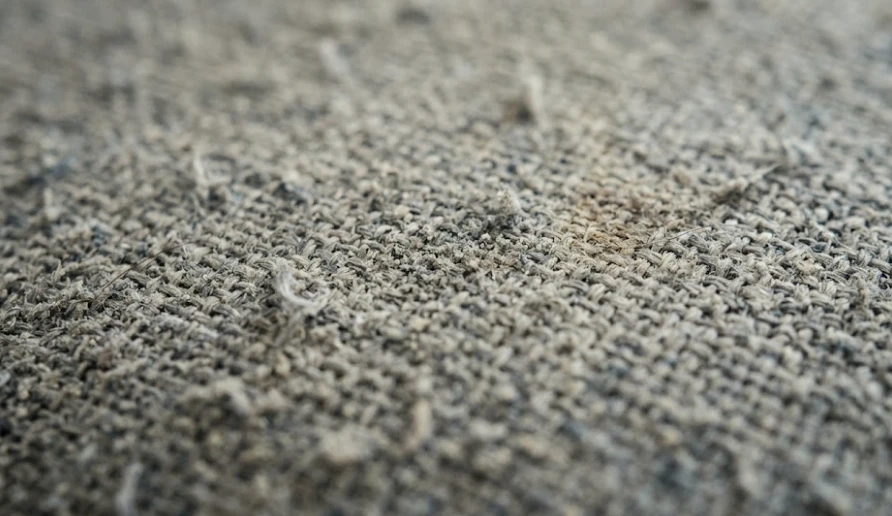
A reader wrote in last month describing something that comes up more often than people realize: she’d been to her doctor twice about morning congestion and itchy eyes that seemed to track with the seasons, got tested for the usual suspects — tree pollen, grass, mold spores — and came back with mild sensitivities to all three but nothing that explained why her symptoms were worse at 7 a.m. on the couch than outside walking the dog. Her allergist, almost as an aside, asked when she’d last had her furniture professionally cleaned. She couldn’t remember. The sofa was four years old and had never been cleaned beyond vacuuming the cushions.
That conversation points to something that doesn’t get nearly enough attention in general health coverage: upholstered furniture is one of the largest reservoirs of indoor allergens in most homes, and in the Pacific Northwest’s climate, it tends to accumulate them faster than furniture in drier regions.
What’s Actually Living in the Cushions
Dust mites are microscopic arachnids — not insects, despite the common description — that feed primarily on shed human skin cells. An adult human sheds roughly 30,000 to 40,000 skin cells per hour, and a meaningful portion of that lands on whatever furniture they’re sitting or sleeping on. A single used mattress can host anywhere from tens of thousands to over a million dust mites, and a frequently used couch in a household with several people isn’t far behind.
The mites themselves aren’t usually the direct allergy trigger. It’s their fecal matter and decomposing bodies, both of which break down into microscopic particles that become airborne when the furniture is sat on, fluffed, or disturbed. These particles are small enough to be inhaled deep into the respiratory tract, and for people with sensitized immune systems, that’s enough to trigger the congestion, sneezing, and eye irritation that gets blamed on everything except its actual source.
Dust mites need humidity above roughly 50% to thrive, and ideally closer to 70-80%. This is where geography starts to matter more than most people expect.
Why Western Washington Homes Are Particularly Vulnerable
Lynnwood sits in a marine climate zone where average relative humidity runs higher than most of the country for much of the year, frequently sitting in the 70-85% range during the wetter months. Homes here tend to stay closed up for long stretches between October and May, with forced-air heating recirculating the same indoor air repeatedly rather than exchanging it with outside air. That combination — elevated ambient humidity and limited fresh air turnover — creates close to ideal conditions for dust mite populations inside upholstered furniture, carpeting, and bedding.
It’s worth contrasting this with somewhere like Phoenix or Denver, where indoor humidity often drops well below the threshold dust mites need to survive, and allergen loads in furniture tend to stay lower regardless of cleaning frequency. The same couch, the same household habits, but a meaningfully different allergen profile depending on which side of the Cascades it’s sitting on. Newer Lynnwood homes built to tighter energy codes compound this slightly — better insulation reduces heating costs, but it also reduces the passive air exchange that older, leakier homes had almost by accident.
Vacuuming Helps Less Than People Assume
Standard vacuuming addresses surface debris reasonably well, but dust mite allergen concentrates in the deeper layers of cushion fill and the underside of upholstery fabric, areas a vacuum’s airflow doesn’t meaningfully penetrate. Several studies on household vacuuming have found that allergen levels in upholstery and carpeting drop only modestly after routine vacuuming and rebound within days, because the source material — skin cells, dander, and the mites themselves — is continuously replenished by normal use.
There’s also a counterintuitive issue with vacuums that lack sealed HEPA filtration: they can increase short-term airborne allergen levels by exhausting fine particles back into the room faster than they settle. Anyone who’s vacuumed a couch and then noticed their eyes itching more for the next hour has experienced this directly, even without connecting the two. None of this means vacuuming is pointless — it’s still useful maintenance — but it explains why a household that vacuums weekly can still have allergen levels in their furniture that a doctor would consider clinically significant.
Pets Add a Layer That’s Easy to Underestimate
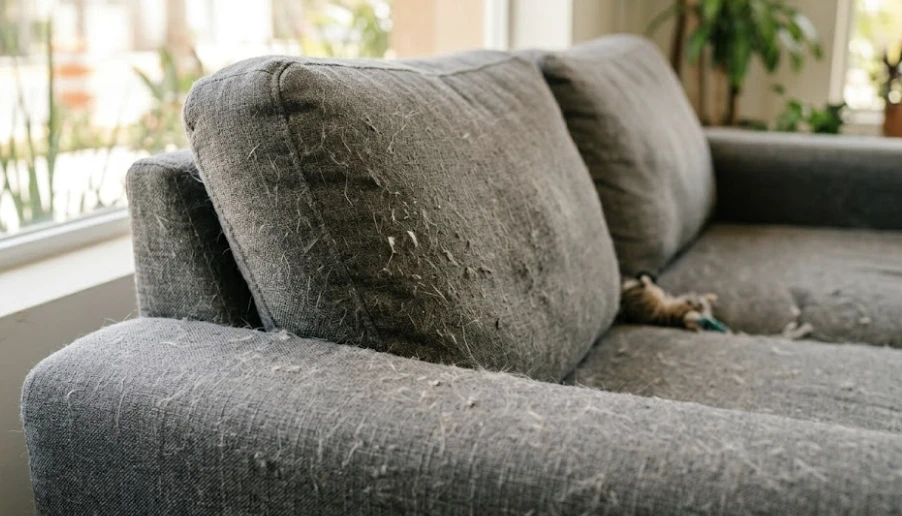
Pet dander particles are smaller than most dust particles — often under 2.5 microns — which means they stay airborne longer and travel further into fabric fibers when they settle. They also carry an electrostatic charge that helps them adhere to upholstery, curtains, and carpeting more readily than larger debris. A cat or dog that spends time on the couch deposits dander continuously, and it doesn’t just sit on the surface — it works into the weave and, for fabrics with any padding, migrates into the layers below.
This matters because pet dander allergens (Fel d 1 from cats is the most studied) are notably persistent. Research on indoor environments has found measurable cat allergen in homes months after a cat was removed, largely because it had become embedded in soft furnishings that weren’t deep-cleaned. For households with pets and ongoing allergy symptoms, the furniture is often a bigger contributor than the pet’s current presence in the room.
What Professional Cleaning Actually Changes
Hot water extraction — the method most professional upholstery cleaners use — applies water heated to roughly 200°F combined with cleaning agents, then extracts both with high-powered vacuum equipment. The heat matters from an allergen standpoint: dust mites and their eggs don’t survive prolonged exposure to temperatures in that range, and the extraction process physically removes a much higher percentage of embedded debris, dander, and allergen particles than surface vacuuming or spot cleaning can reach.
This is different from a cosmetic refresh. The visible result — a cleaner-looking, better-smelling sofa — is almost a side effect of a process that’s primarily addressing what’s embedded in the fabric and padding, not just what’s visible on the surface. For households dealing with unexplained or seasonal-seeming allergy symptoms that don’t fully track with outdoor pollen counts, upholstery cleaning services Lynnwood residents have access to locally are worth considering as part of the picture an allergist would want to know about, not just a household chore.
Most professional guidance suggests upholstered furniture in regularly used living spaces benefits from this kind of deep cleaning every six to twelve months, with the shorter end making more sense for households with pets, children, or anyone with diagnosed allergies or asthma.
A Few Things Worth Checking at Home
If allergy-type symptoms seem worse in certain rooms, or worse right after sitting on the couch or right after waking up, that’s a pattern worth paying attention to rather than dismissing as “just allergies acting up again.” Symptoms that improve noticeably after time away from the house, even during high pollen periods, point toward an indoor source rather than an outdoor one.
Removable cushion covers, where they exist, can be washed in hot water periodically, which helps with the surface layer. But for furniture without removable covers, or for the padding and structural layers that washing can’t reach, professional cleaning is really the only method that addresses the problem at the depth where it’s occurring.
It’s a small thing to check before assuming a new air purifier, a different allergy medication, or another round of testing is the answer. Sometimes the source has been sitting in the living room the whole time.